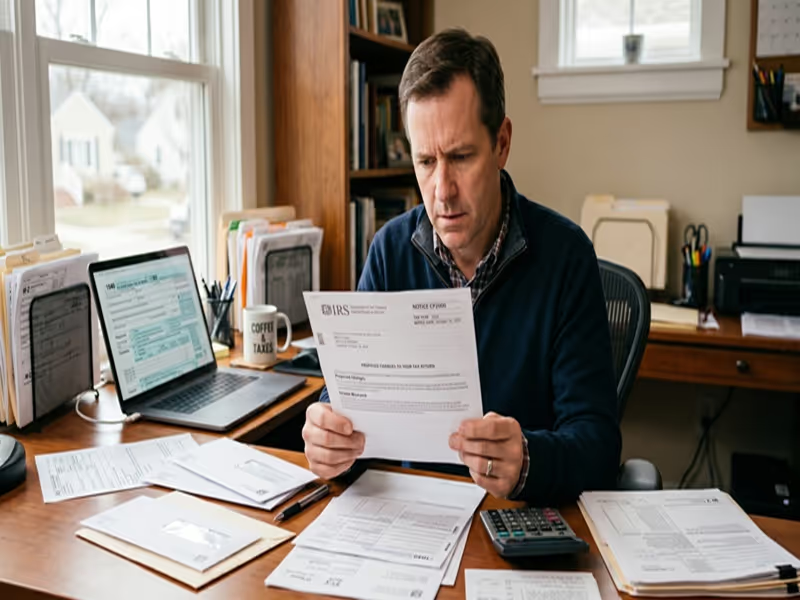
Received an IRS CP2000 notice? Learn what it means, why you got it, and how to respond correctly — with a free response letter template. GTA Accounting Group explains everything step by step.
Receiving a notice from the IRS can be a stressful and confusing experience, especially when you are not sure what it means or what action you are supposed to take. If you recently opened your mail and found an IRS CP2000 notice, take a deep breath. You are not alone, and this is not as serious as it may first appear.
A CP2000 notice is generated automatically by the IRS when the income reported on your tax return does not match information submitted by third parties such as employers, banks, or brokerage firms. It is not an audit, and in many cases, it is triggered by a simple clerical error or missing form.
This guide by GTA Accounting Group walks you through exactly what this notice means, why you received it, and how to respond step-by-step so you can resolve the issue confidently and correctly without paying more than you owe.
What Is an IRS CP2000 Notice?
An IRS CP2000 notice is an official letter sent to taxpayers when the Internal Revenue Service detects a discrepancy between the income reported on their tax return and the income reported by third-party sources such as employers (via W-2 forms), clients (via 1099 forms), banks, or brokerage firms.
The notice is generated through the IRS Automated Underreporter (AUR) Program, which uses a computer system to match data reported by taxpayers with data reported by third parties. When a mismatch is detected, the IRS automatically issues a CP2000 proposing an adjustment to your tax liability.
Important: A CP2000 is NOT a final bill and NOT an audit. It is a proposed adjustment. The IRS is essentially saying: "Our records show different income than what you reported. Please review and confirm or dispute this difference." You have the right to agree, disagree, or partially agree with the notice.
Why Did You Receive a CP2000 Notice?
There are several reasons why the IRS might send you a CP2000 notice. Most of them are unintentional and can be resolved with the right documentation. Here are the most common causes:
Missing 1099 Income
One of the most frequent triggers is a missing 1099 form. If a client, freelance platform, or financial institution reported income paid to you via a 1099-NEC, 1099-MISC, or 1099-INT, but you did not include that income in your tax return, the IRS system will catch the mismatch. Even if the amount seems small, the IRS computer flags every discrepancy it finds.
Brokerage Mismatches and Investment Income
Brokerage firms are required to report your investment transactions directly to the IRS using 1099-B and 1099-DIV forms. If you sold stocks, received dividends, earned interest, or had any capital gains that you either underreported or reported incorrectly, the IRS will detect the difference. This is especially common when taxpayers report only net gains but do not include complete details on Schedule D.
Crypto and Stock Reporting Issues
Cryptocurrency exchanges now report transactions to the IRS under updated 1099-DA reporting requirements. Many taxpayers are unaware that selling, trading, or converting crypto is a taxable event. If your exchange reported transactions that you did not include on your return, a CP2000 notice is very likely. Similarly, partial reporting of stock option exercises or ESPP sales can also trigger mismatches.
Employer Reporting Errors
Sometimes the error is not yours at all. Employers may submit incorrect W-2 forms, report duplicate wages, or make clerical mistakes with Social Security numbers. In these cases, your CP2000 notice is the result of a third-party error, and you will need to obtain a corrected W-2 or 1099 to dispute the IRS adjustment with supporting evidence.
When Does the IRS Send a CP2000 Notice?
Many taxpayers are surprised when they receive a CP2000 notice months or even years after filing their return. Understanding the timeline can help reduce unnecessary panic.
Typical Timeline: 6 to 12 Months
The IRS generally does not send CP2000 notices immediately after you file. The typical timeline is 6 to 12 months after your original return is processed. This delay occurs because the IRS must first collect all third-party data, run its matching system, verify discrepancies, and then generate and mail the notice.
Why Notices Arrive Late
Third-party data reporting is not always immediate. Brokerage firms, payment processors, and other institutions sometimes submit corrected or late 1099 forms well after the original filing deadline. When the IRS receives updated or corrected data, it reruns its matching process, which can push notice generation back by many additional months. IRS backlogs and staffing delays also contribute to notices arriving late.
Is a CP2000 Notice an Audit?
No. A CP2000 notice is absolutely not an audit, and this distinction is extremely important to understand.
An IRS audit is a formal, in-depth examination of your entire tax return, your records, and potentially your financial accounts. It can involve correspondence by mail, an in-person meeting at an IRS office, or even an examination at your home or place of business.
A CP2000 notice, on the other hand, is a computer-generated letter flagging one specific type of mismatch: a difference in reported income. It is narrower in scope, generated automatically, and only proposes an adjustment based on income discrepancies. That said, even though it is not an audit, you should still treat it seriously. Ignoring a CP2000 can eventually escalate the matter and lead to greater problems.
What to Do After Receiving a CP2000 Notice (Step-by-Step)
Once you receive the notice, follow these five steps carefully to handle it correctly:
Step 1 — Review the Notice Carefully
Read the entire CP2000 notice from beginning to end. The notice will clearly state: the tax year in question, the specific income items the IRS believes were underreported, the proposed additional tax amount, any interest or penalties being suggested, and the deadline by which you must respond. Do not panic. Take your time and understand exactly what the IRS is claiming.
Step 2 — Compare With Your Tax Return and Income Documents
Pull out a copy of the tax return for the year mentioned in the notice. Then gather all your original income documents for that year — W-2s, 1099s, brokerage statements, and bank records. Compare the income figures on those documents with what is shown in the CP2000 notice. Look carefully for any duplicates, income that was already reported, or amounts already accounted for under a different category.
Step 3 — Decide: Agree or Disagree
After reviewing the documents, decide whether the IRS is correct or not. You may fully agree, partially agree, or fully disagree with the proposed changes. If the IRS is right and you did miss reporting some income, agreeing quickly and paying any owed amount promptly can minimize additional interest. If you believe the IRS is wrong, you have every right to dispute it with proper documentation.
Step 4 — Prepare Your Response
Whether you agree or disagree, you must prepare a written response. If you agree, sign and date the response form included with the notice. If you disagree, write a clear explanation letter and attach all supporting documents such as corrected W-2s, 1099 forms, brokerage statements, or any other records that prove your case. Keep copies of everything you send to the IRS.
Step 5 — Send Your Response Before the Deadline
The response deadline is clearly printed on your CP2000 notice and is typically 30 days from the date of the notice. Send your response via certified mail with return receipt so you have proof of submission. Never ignore or miss this deadline, as doing so gives the IRS permission to make the proposed adjustment automatically and issue a formal tax bill.
If You Agree With the CP2000 Notice
If your review confirms that the IRS is correct and you did underreport income, the process is straightforward.
How to Sign and Return the Agreement Form
The CP2000 notice comes with a response form attached. If you agree with all the proposed changes, simply sign and date the agreement section and mail it back to the IRS at the address listed on the notice. Do this as soon as possible to stop additional interest from accumulating.
Payment Options for the Additional Tax Owed
If the proposed adjustment results in additional tax owed, you can pay the full amount online through the IRS Direct Pay portal, by check made payable to the U.S. Treasury, or via Electronic Funds Withdrawal. Paying the full amount quickly reduces the interest that continues to accumulate on the unpaid balance.
What If You Cannot Pay in Full? Installment Plans
If you cannot afford to pay the full amount at once, you can request a payment plan or installment agreement from the IRS. You can apply online at IRS.gov or include a written request with your CP2000 response. An installment plan allows you to pay the balance in monthly installments, though interest and a small setup fee may still apply.
If You Disagree With the CP2000 Notice
If you believe the IRS has made an error, you have every right to dispute the notice. Here is how to do it correctly.
Gather Supporting Documents
To dispute a CP2000 notice, you will need strong documentation. This may include corrected W-2 or 1099 forms from the issuer, brokerage statements showing the correct income figures, bank statements, proof of previously reported income, or a letter from your employer confirming a reporting error. The more documentation you can provide, the stronger your case will be.
Write a Clear Explanation Letter
Along with your supporting documents, you must include a clear written explanation describing why you disagree with the IRS adjustment. Be specific, professional, and factual. Explain exactly where the discrepancy originated, what the correct figures are, and why the income was either already reported or does not apply to your tax situation.
Common Mistakes to Avoid When Disputing
Many taxpayers make the mistake of responding without proper documentation, which weakens their case. Others miss the deadline entirely, which allows the IRS to proceed with the adjustment automatically. Always send copies of documents (never originals), always meet the deadline, and always be specific in your written explanation.
CP2000 Response Letter Sample (Free Template)
Use this sample template as a starting point for your own CP2000 response letter. Customize it with your specific details before mailing:
CP2000 Response Letter — Template
[Your Full Name]
[Your Address]
[City, State, ZIP Code]
[Your Social Security Number]
[Date]
Internal Revenue Service
[Address shown on your CP2000 notice]
RE: Response to CP2000 Notice | Tax Year: [YEAR] | Notice Date: [DATE ON NOTICE]
Dear IRS Automated Underreporter Unit,
I am writing in response to the CP2000 notice dated [DATE] for the tax year [YEAR]. After carefully reviewing the proposed changes, I respectfully [agree with / disagree with / partially disagree with] the adjustments proposed.
[If Disagreeing]: The income referenced in the notice was already included in my original tax return under [describe where it was reported]. I have attached supporting documentation including [list documents: W-2, 1099, brokerage statement, etc.] to verify the accuracy of my original filing.
I respectfully request that you review the attached documents and adjust my account accordingly. Please contact me at [Your Phone Number] or [Your Email Address] if any additional information is required.
Sincerely,
[Your Signature]
[Your Printed Name]
CP2000 Response Deadline: How Many Days Do You Have?
The standard deadline to respond to a CP2000 notice is 30 days from the date printed on the notice, not the date you received it. This is an important distinction, especially if the notice was delayed in the mail. Always look at the date on the notice itself and count 30 days from that date.
If you need additional time, you can call the IRS using the phone number on your notice and request a 30-day extension before the deadline passes. Extensions are not always guaranteed, but the IRS often grants them when requested in advance. If you miss the deadline without any contact, the IRS will typically proceed with issuing a formal Notice of Deficiency, which gives you 90 days to petition the U.S. Tax Court if you still wish to dispute the adjustment.
What Happens If You Ignore a CP2000 Notice?
Ignoring a CP2000 notice is one of the worst mistakes a taxpayer can make. The consequences of non-response escalate quickly and can become much more difficult and expensive to resolve over time.
Here is what happens if you ignore it:
- The IRS automatically adjusts your tax return based on their records, which may increase your tax liability significantly.
- Interest begins to accumulate on the unpaid balance from the original due date of your return.
- An accuracy-related penalty of up to 20% of the underpayment may be assessed.
- The IRS may issue a Statutory Notice of Deficiency, which triggers the formal assessment process.
- In severe or repeated cases, collection actions such as tax liens or levies may eventually follow.
CP2000 Penalties: Willful vs Non-Willful Cases
Understanding the difference between willful and non-willful underreporting is important because the penalties differ significantly.
Interest
Interest accrues on any unpaid tax balance from the original due date of your return. The IRS interest rate is tied to the federal short-term rate plus 3%. This interest compounds daily and can add up quickly if the balance remains unpaid for months or years.
Accuracy-Related Penalty (Non-Willful)
For non-willful cases where the underreporting was an honest mistake, the IRS typically imposes an accuracy-related penalty of 20% of the underpaid tax. This penalty can sometimes be waived or reduced if you can demonstrate reasonable cause and good faith, such as relying on incorrect information from a third party.
Fraud Penalty (Willful Cases)
In cases where the IRS determines that income was willfully concealed or fraud was involved, the civil fraud penalty can reach 75% of the underpayment. Willful tax evasion can also result in criminal charges. However, the vast majority of CP2000 notices involve honest, non-willful errors and never reach this level of severity.
Common CP2000 Mistakes to Avoid
Taxpayers often make these avoidable mistakes when handling a CP2000 notice:
- Ignoring the notice entirely, assuming it will go away on its own.
- Paying the proposed amount without checking whether the IRS figures are actually correct.
- Responding without attaching any documentation to support their position.
- Missing the 30-day response deadline, which removes their right to dispute easily.
- Sending original documents instead of copies, risking permanent loss of important records.
- Confusing a CP2000 notice with an audit and becoming unnecessarily frightened about the process.
CP2000 vs CP90 vs Other IRS Notices
Not all IRS notices are the same, and it is important to understand which type you have received because each requires a different response.
CP2000 — Proposed Adjustment for Underreported Income
A CP2000 is a computer-generated mismatch notice proposing an income adjustment. It is not a final bill. You have 30 days to agree, disagree, or partially disagree. No immediate payment is required at this stage.
CP90 — Final Notice of Intent to Levy
A CP90 is a serious, final-stage notice that means the IRS is about to take collection action, including seizing wages, bank accounts, or assets. If you receive a CP90, you need professional help immediately. This is a much later-stage notice than a CP2000.
CP3219A — Statutory Notice of Deficiency
This notice is issued if you ignored your CP2000 and the 30-day window has passed. It gives you 90 days to petition the U.S. Tax Court. If you receive this notice, act immediately and contact a tax professional.
When Should You Seek Professional Help?
A licensed tax professional or enrolled agent can make the entire CP2000 process significantly easier, faster, and more favorable for you.
You should consider hiring a tax professional if:
- The proposed tax adjustment is significant.
- Your situation involves multiple income sources or complex investment activity.
- You have already received prior IRS notices on the same issue.
- You are unsure whether to agree or disagree with the adjustment.
- The deadline is approaching and you do not know what to do.
- Your case involves cryptocurrency transactions, business income mismatches, S-corporation or partnership K-1 discrepancies, or foreign income reporting.
Frequently Asked Questions (FAQ)
What is a CP2000 notice from the IRS?
A CP2000 is a notice the IRS sends when the income on your tax return does not match income data reported by employers, banks, or other third parties. It proposes an adjustment but is not a final bill or an audit.
Is a CP2000 notice serious?
It should be taken seriously, but it is not as severe as an audit or a final collection notice. Most CP2000 cases are resolved easily when you respond on time with proper documentation. Ignoring it is what makes it serious.
Can I ignore the CP2000 notice?
No. Ignoring the notice allows the IRS to automatically adjust your tax return, assess additional taxes, add interest and penalties, and eventually begin collection action. Always respond within the 30-day deadline.
How do I respond to a CP2000 notice?
Review the notice carefully, compare it with your tax records, decide whether you agree or disagree, prepare a written response with supporting documents, and mail it to the IRS by certified mail before the deadline. A tax professional can handle this entire process on your behalf.
How long does the IRS take to respond after I submit my CP2000 reply?
The IRS typically takes 8 to 12 weeks to review and respond to a CP2000 reply, though processing times can vary depending on volume and backlog. You may receive a notice accepting your response, requesting additional information, or issuing a final determination.
Final Thoughts
A CP2000 notice may feel overwhelming when you first open it, but it is a manageable situation when handled correctly and on time. The most important things to remember are: do not panic, do not ignore it, read it carefully, verify your own records, and respond within the 30-day deadline.
Most CP2000 cases are resolved without major consequences when the taxpayer responds promptly with clear documentation. If you are unsure about any step of the process or if your case involves complex income sources, working with a qualified tax professional is the smartest investment you can make.
Get Professional Help from GTA Accounting Group
If you have received a CP2000 notice and are unsure how to respond, GTA Accounting Group is here to help. Our team of experienced tax professionals has helped hundreds of clients successfully resolve IRS notices, minimize penalties, and protect their financial interests.
Our services include:
- CP2000 notice review and analysis
- Professional IRS response letter preparation
- IRS communication and representation
- Penalty reduction and abatement strategies
- Tax return preparation and amendment filing
- Business and personal bookkeeping and accounting
- IRS audit representation and back tax resolution
Do not face the IRS alone. Contact GTA Accounting Group today and let our professionals handle your CP2000 notice with the expertise and attention it deserves.