
Founder of GTA Accounting Group, Sohail helps businesses grow with expert tax strategies and financial planning.
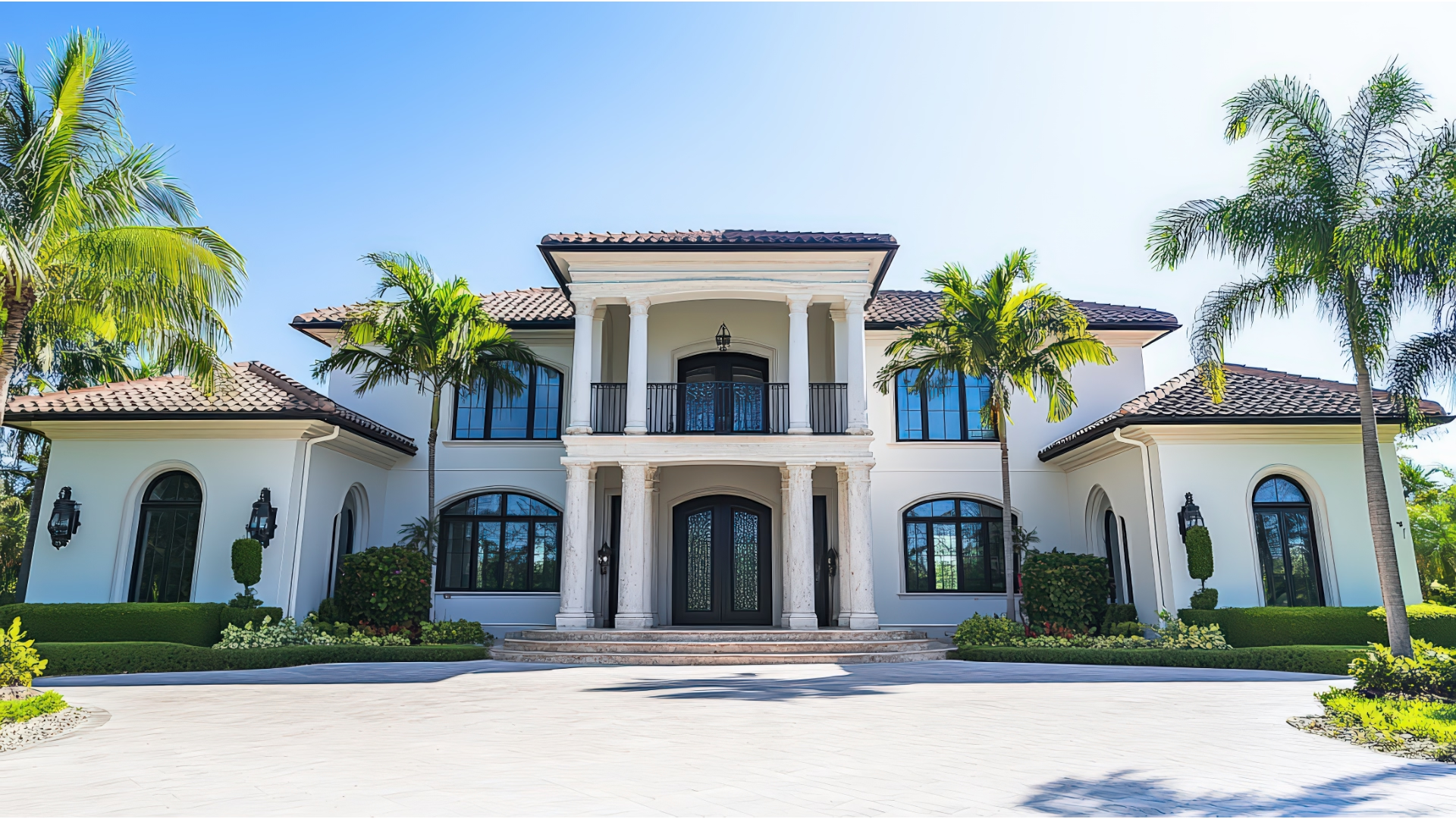
The NJ mansion tax is now tiered 1%–3.5% and the seller pays (since July 2025). See 2026 rates, who owes it, exemptions, and the pricing-cliff trap.
Buying or selling a high-value home in New Jersey involves more than the sale price and financing. One cost that catches people off guard is the NJ Mansion Tax — a one-time state fee on residential transfers of $1 million or more. The rules changed significantly on July 10, 2025: the tax is no longer a flat 1%, and it is no longer paid by the buyer.
Quick answer: In New Jersey, the "mansion tax" — officially the Graduated Percent Fee — applies to residential property sold for over $1 million. Since July 10, 2025, the seller (grantor) pays it, not the buyer, and the old flat 1% is now a tiered 1% to 3.5% rate set by the sale price. The rate applies to the entire price, so crossing a bracket by a single dollar can raise the bill by tens of thousands.
The Mansion Tax in New Jersey is a one-time state fee applied to the transfer of residential property valued at $1 million or more. It was introduced in 2004 under the Realty Transfer Fee (RTF) Act to raise revenue from high-value real estate sales. In 2025 the Legislature overhauled it through P.L. 2025, c. 69, replacing the flat 1% with a graduated schedule and shifting the payment obligation to the seller.
Although commonly called a "luxury home" tax, it applies to any qualifying residential property — a single-family home, condominium, or cooperative unit — sold for $1 million or more, regardless of size or location.
The mansion tax applies when the consideration (sale price) of a residential property equals or exceeds $1 million. It is due when the deed is recorded with the county clerk.
Sellers or buyers who are unsure whether a transaction qualifies can consult New Jersey State Tax Services for a professional review before closing.
The 2025 amendments also raised fees on certain non-residential (commercial) transfers over $1 million, which follow their own rules. Commercial and mixed-use deals should be reviewed individually — see the FAQ below and speak with our team.
For any residential transfer with a deed recorded on or after July 10, 2025, the flat 1% has been replaced by a graduated schedule:
| Sale price (consideration) | Rate |
|---|---|
| Over $1,000,000, up to $2,000,000 | 1% |
| Over $2,000,000, up to $2,500,000 | 2% |
| Over $2,500,000, up to $3,000,000 | 2.5% |
| Over $3,000,000, up to $3,500,000 | 3% |
| Over $3,500,000 | 3.5% |
The rate is set by the total sale price and applied to the entire amount — it is not tiered the way income tax brackets are. A $2.1 million sale is taxed at 2% on the full $2.1 million, not just the portion above $2 million.
| Sale price | Rate | Mansion tax due |
|---|---|---|
| $1,500,000 | 1% | $15,000 |
| $2,000,000 | 1% | $20,000 |
| $2,100,000 | 2% | $42,000 |
| $2,600,000 | 2.5% | $65,000 |
| $3,200,000 | 3% | $96,000 |
| $4,000,000 | 3.5% | $140,000 |
Because a small increase in price can push a sale into a higher bracket on the whole amount, precise pricing matters. Working with experts in State Tax Planning and Consulting helps ensure accurate calculation and timely filing.
Since the rate applies to the full sale price, a sale priced just above a bracket line can net the seller less than a sale at the line. Selling at $2,000,001 instead of $2,000,000 adds $20,000 in tax to gain $1 in price.
Each bracket has a "dead zone" just above it where a higher price leaves the seller with less in their pocket:
| Bracket price | Net after tax | Dead zone (avoid pricing here) |
|---|---|---|
| $2,000,000 (1%) | $1,980,000 | $2,000,001 – $2,020,408 |
| $2,500,000 (2%) | $2,450,000 | $2,500,001 – $2,512,821 |
| $3,000,000 (2.5%) | $2,925,000 | $3,000,001 – $3,015,464 |
| $3,500,000 (3%) | $3,395,000 | $3,500,001 – $3,518,135 |
If an offer lands inside a dead zone, the seller often nets more by accepting the bracket price instead. A CPA-led review before you list or accept an offer can keep a deal out of these traps.
Since July 10, 2025, the seller (grantor) is responsible for paying the mansion tax under N.J.S.A. 46:15-7.2. Before that date, the buyer (grantee) paid it — which is why a great deal of older guidance still online says the opposite.
The tax is due when the deed is recorded, and payment is typically handled by the seller's attorney or the title company. The State looks to the seller for payment; if an audit finds an underpayment, the grantor is liable.
Buyers and sellers may contractually agree to allocate the cost differently, but that is a private arrangement between the parties — the Division of Taxation still holds the seller responsible and directs questions about contract allocation to private legal counsel. Both parties should confirm how the fee is handled in the contract of sale.
Certain transactions are exempt from the NJ Mansion Tax, depending on the property or the relationship between the parties.
The graduated residential schedule above applies to residential property. Commercial and industrial transfers are treated separately under the 2025 law and should be reviewed individually through Property Tax Assessment and Appeal Services, especially for mixed-use developments.
Transfers between spouses, parents and children, or within a trust are typically exempt. Transfers resulting from inheritance, divorce settlements, or gifts may also qualify. Verify exemption status with a tax professional before closing to avoid unnecessary payments.
"The buyer pays." Not since July 10, 2025 — the seller now pays. Guidance that still says the buyer pays is out of date.
"It's a flat 1%." No longer true. The rate is graduated from 1% to 3.5% based on the sale price.
"It only affects mansions." Any residential property at or above $1 million triggers the tax, regardless of size or style.
"It replaces the transfer fee." It does not — the base Realty Transfer Fee is a separate charge, and both can apply.
The RTF-1EE (Affidavit of Consideration) documents the total consideration, any exemptions, and the amount of mansion tax due. It is submitted to the county recording office along with the deed.
The form and payment are submitted at closing, typically by the seller's attorney or the title company. For accuracy and compliance, sellers often engage professionals offering State Tax Planning and Consulting services.
Failure to pay the mansion tax can result in:
New Jersey also enforces a Millionaire's Tax, which is completely separate from the mansion tax.
A person selling a $1.5 million home may owe the mansion tax even if their income is well below the millionaire threshold. Understanding both helps with planning — especially alongside Tax Credits and Incentives in New Jersey.
Under the 2025 law, the mansion tax is now a seller-side cost that comes straight off net proceeds. On a $4 million sale, that is $140,000 off the top — not the $40,000 the old flat 1% would have implied. Sellers in high-value markets such as Bergen, Hudson, Essex, and Monmouth Counties should factor it into their net-proceeds math before listing.
A pre-listing consultation with State Tax Planning and Consulting professionals ensures the rate, exemptions, and pricing strategy are reviewed before you finalize the deal.
The NJ Mansion Tax can be confusing, and the 2025 changes mean a lot of online guidance is now wrong. Misunderstanding who pays, the rate, or the filing steps can be costly.
GTA Accounting Group provides New Jersey State Tax Services, covering compliance, documentation, and payment assistance for real estate transactions. Our CPA team helps ensure accuracy across property-related filings, including realty transfer documentation and amendment filings.
If you are buying or selling a residential property worth $1 million or more, contact GTA Accounting Group for professional help with tax preparation and filing assistance for a smooth, compliant transfer.
1. What triggers the NJ Mansion Tax?
Any residential property sale of $1 million or more triggers the mansion tax at the time of deed recording.
2. Who pays the mansion tax in New Jersey?
Since July 10, 2025, the seller (grantor) pays it. Before that date the buyer paid — the responsibility shifted under P.L. 2025, c. 69.
3. Did the NJ mansion tax change in 2025?
Yes. Effective July 10, 2025, the flat 1% became a graduated 1%–3.5% rate based on sale price, and the seller now pays instead of the buyer.
4. How much is the NJ mansion tax on a $2 million home?
A $2 million sale is taxed at 1% ($20,000). A sale just above $2 million jumps to 2% on the full price — for example, $2.1 million is taxed at 2% ($42,000).
5. Are commercial properties subject to the mansion tax?
The 2025 law also increased fees on certain non-residential transfers over $1 million, and commercial deals carry their own rules. Have a commercial or mixed-use transaction reviewed by a CPA before closing.
6. Can a CPA help with my mansion tax liability?
Yes. A CPA can confirm the correct rate, identify exemptions, advise on pricing around bracket lines, and ensure the RTF-1EE is filed correctly to avoid penalties.
Buying or selling near a mansion-tax threshold? Our New Jersey capital gains tax services and property & real estate tax accounting help you plan around the pricing cliffs.
Navigating the NJ mansion tax?
Get expert guidance before you buy or sell above the mansion-tax threshold in New Jersey.
Book a free consultationExperience the difference with our tailored accounting solutions. Let's transform your financial landscape together. Get in touch for a consultation!
Get in touch
At GTA Accounting Group, we value proactive clients — which is why when you book an appointment, you'll also receive an exclusive offer designed to help you save more, plan better, and make confident financial decisions.
Simply fill out the form, and our team will reach out to confirm your appointment and deliver your award. It only takes 30 seconds and gets you one step closer to expert support.
Use the form below to