
Founder of GTA Accounting Group, Sohail helps businesses grow with expert tax strategies and financial planning.
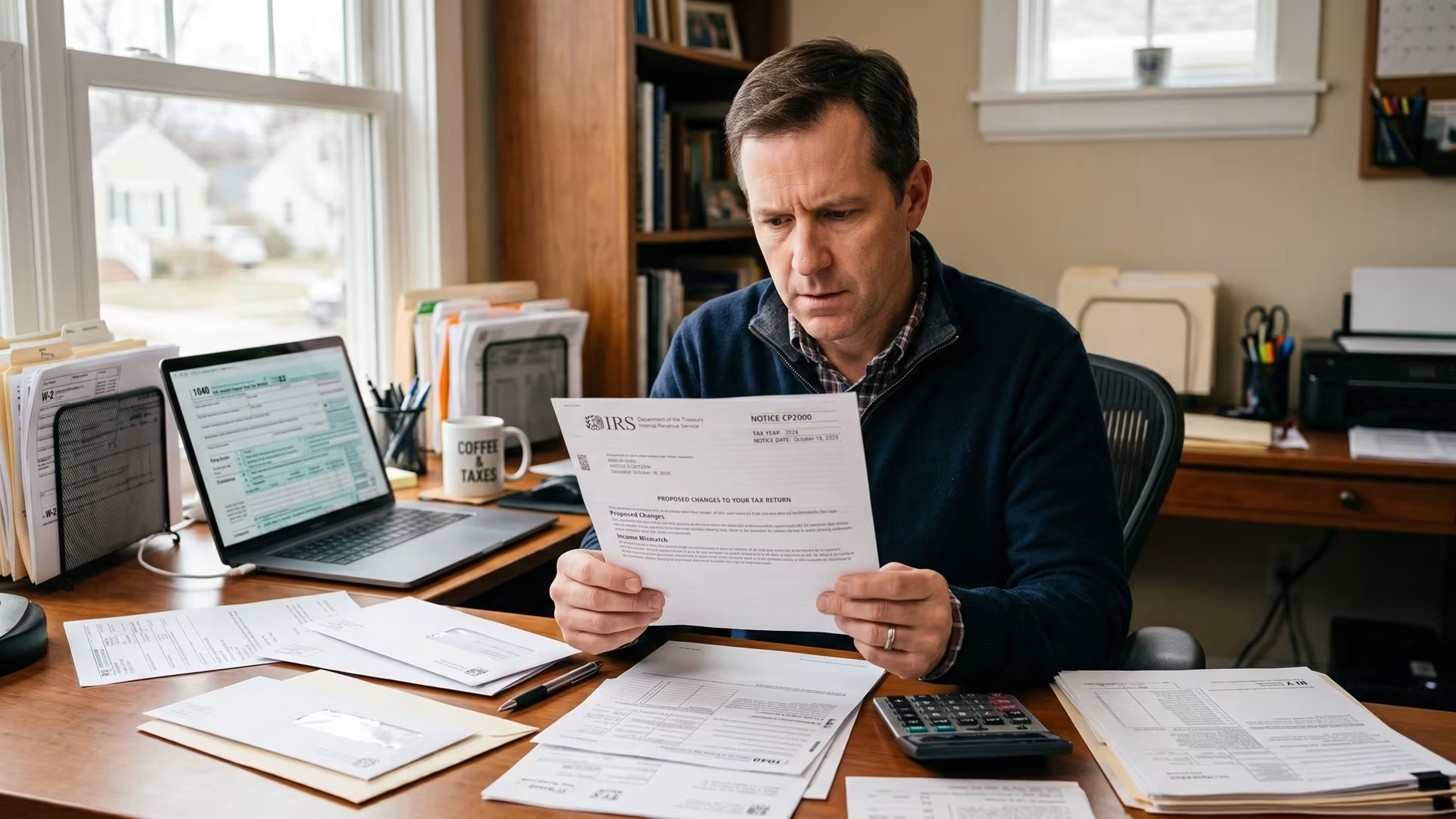
Three free CP2000 response letter templates, one for each situation, plus the Response form rule most sample letters get wrong and the three ways the IRS accepts a reply.
A CP2000 response letter tells the IRS whether you agree or disagree with the income it says you left off your return, and attaches the proof. It travels with the Response form that came in your notice, not instead of it. Three free samples are below, one for each situation, followed by the three ways the IRS accepts them.
A CP2000 is not an audit. It is an automated notice, generated when income reported to the IRS by an employer, bank or brokerage does not match what appears on your return. Most are resolved with one letter and the right attachments.
| The short version | What to do |
|---|---|
| What the IRS actually wants back | The Response form from your notice, signed, with the agree or disagree box checked |
| What the letter is for | Explaining a disagreement and listing what you attached. It supports the Response form |
| Deadline | The due date printed on your notice |
| Fastest way to send it | The IRS Document Upload Tool |
| Filed jointly? | Both spouses must sign the CP2000 Response form |
| Documents | Send copies. Never send originals |
This is where most sample letters found online quietly mislead people. The IRS asks you to complete and sign the Response form included with your notice and to state on it whether you agree or disagree. A letter on its own is not the response. Use the letter to explain why you disagree and to list your attachments, then send it together with the signed Response form.
If your notice did not include a Response form, follow the instructions printed on the notice itself. And if you filed a joint return, the IRS requires both spouses to sign the CP2000 Response form. A single signature is one of the most common reasons a reply gets sent back.
The most common case. Use this when the income was already reported, was reported by someone else in error, or was offset by basis or expenses the IRS could not see.
[Your Full Name]
[Your Address]
[City, State, ZIP Code]
[Your Social Security Number]
[Your Daytime Phone Number]
[Date]
Internal Revenue Service
[Use the address, fax number or upload option shown on your notice]
RE: Response to Notice CP2000 | Tax Year: [YEAR] | Notice Date: [DATE ON NOTICE] | AUR Control Number: [FROM YOUR NOTICE]
Dear IRS Automated Underreporter Unit,
I am responding to the CP2000 notice dated [DATE] regarding my [YEAR] Form 1040. I have reviewed the proposed changes and I disagree with them, for the reason set out below.
The [describe the income, for example: $[AMOUNT] reported on Form 1099-B by [PAYER]] was already included in my original return at [say exactly where, for example: Schedule D, line 7]. The notice appears to reflect [gross proceeds without cost basis / income reported under an incorrect taxpayer identification number / a duplicate information return].
I have enclosed copies of the following in support: [list each document, for example: the brokerage statement showing a cost basis of $[AMOUNT]; the corrected Form 1099; the relevant page of my filed return].
I respectfully ask that you review the enclosed documents and adjust the proposed changes accordingly.
I have enclosed the signed Response form from the notice. Please contact me at [Your Phone Number] if you need anything further to resolve this.
Sincerely,
[Your Signature]
[Your Printed Name]
Attach: signed Response form with the disagree box checked, plus copies of every document listed above.
If the IRS is right and you have nothing else to add, the Response form alone is usually enough. Use this short letter only if you want to record how you are paying.
[Your Full Name]
[Your Address]
[City, State, ZIP Code]
[Your Social Security Number]
[Your Daytime Phone Number]
[Date]
Internal Revenue Service
[Use the address, fax number or upload option shown on your notice]
RE: Response to Notice CP2000 | Tax Year: [YEAR] | Notice Date: [DATE ON NOTICE] | AUR Control Number: [FROM YOUR NOTICE]
Dear IRS Automated Underreporter Unit,
I am responding to the CP2000 notice dated [DATE] regarding my [YEAR] Form 1040. I have reviewed the proposed changes and I agree with them.
I have enclosed the signed Response form. [Choose one: I have enclosed payment of $[AMOUNT] by check, made payable to "United States Treasury" and marked with my Social Security number, the tax year and "CP2000." / I have paid $[AMOUNT] online at IRS.gov on [DATE]. / I am unable to pay in full and have requested a payment plan.]
I have enclosed the signed Response form from the notice. Please contact me at [Your Phone Number] if you need anything further to resolve this.
Sincerely,
[Your Signature]
[Your Printed Name]
If you agree and have no other income, credits or expenses to report, the IRS does not want an amended return. Do not file one.
Common when the IRS caught one real omission but also double-counted something. Be explicit about which line you accept and which you dispute.
[Your Full Name]
[Your Address]
[City, State, ZIP Code]
[Your Social Security Number]
[Your Daytime Phone Number]
[Date]
Internal Revenue Service
[Use the address, fax number or upload option shown on your notice]
RE: Response to Notice CP2000 | Tax Year: [YEAR] | Notice Date: [DATE ON NOTICE] | AUR Control Number: [FROM YOUR NOTICE]
Dear IRS Automated Underreporter Unit,
I am responding to the CP2000 notice dated [DATE] regarding my [YEAR] Form 1040. I agree with part of the proposed changes and disagree with the remainder.
I agree with: the [DESCRIBE ITEM] of $[AMOUNT]. This was omitted from my return in error.
I disagree with: the [DESCRIBE ITEM] of $[AMOUNT], because [state the reason, for example: this amount was already reported on Schedule C, line 1 / this Form 1099 duplicates income already reported by another payer].
I have enclosed copies of [list documents] supporting the portion I dispute. Based on the item I accept, I calculate the additional tax to be $[AMOUNT].
I have enclosed the signed Response form from the notice. Please contact me at [Your Phone Number] if you need anything further to resolve this.
Sincerely,
[Your Signature]
[Your Printed Name]
Do not check the "agree" box when you disagree with any part. Check disagree and explain the split.
The IRS accepts a CP2000 reply three ways. Use whichever your notice allows, but the upload tool is the one the IRS itself calls fastest.
| Method | How it works | Worth knowing |
|---|---|---|
| Upload (fastest) | The IRS Document Upload Tool, using the access code printed on your notice. Accepts JPG, PNG or PDF | Digital and immediate. No postal delay and no question about whether it arrived |
| Fax | Send to the number for the IRS location shown at the top left of your notice | If you use an online fax service, check its privacy and security policy first |
| Send to the address in the top left corner of page one of your notice | Consider certified mail so you have proof of the date you sent it |
The fax number depends on which IRS campus issued your notice:
| If your notice came from | Fax your response to |
|---|---|
| Andover, MA | 877-477-9485 |
| Atlanta, GA | 877-477-0967 |
| Austin, TX | 877-477-0583 |
| Fresno, CA | 877-477-0962 |
| Holtsville, NY | 877-477-9599 |
| Ogden, UT | 877-477-9640 |
| Philadelphia, PA | 877-477-9602 |
Two related cases worth knowing. If the notice is correct and you have other income, credits or expenses to report, complete Form 1040-X, write “CP2000” on the top, and send it with your Response form. If you believe someone used your name and Social Security number, send Form 14039, Identity Theft Affidavit, with your reply.
Reply by the due date printed on your notice. That date, not the day the envelope reached you, is the one the IRS works from, which matters when post is slow. In practice the window is usually about 30 days from the notice date, but the printed due date governs, so read it rather than counting.
If you need longer, you can request an extension by mail, by fax, or by calling the toll-free number on the notice. Ask before the due date passes. Extensions are not guaranteed, but the IRS does grant them, and requesting one is far better than going quiet.
If you neither reply nor request more time, the IRS can assess the additional tax and will normally issue a Notice of Deficiency (CP3219A). That starts a 90-day window to petition the U.S. Tax Court, which is a slower and more formal road than answering the CP2000 was.
An IRS CP2000 notice is an official letter sent to taxpayers when the Internal Revenue Service detects a discrepancy between the income reported on their tax return and the income reported by third-party sources such as employers (via W-2 forms), clients (via 1099 forms), banks, or brokerage firms.
The notice is generated through the IRS Automated Underreporter (AUR) Program, which uses a computer system to match data reported by taxpayers with data reported by third parties. When a mismatch is detected, the IRS automatically issues a CP2000 proposing an adjustment to your tax liability.
Important: A CP2000 is NOT a final bill and NOT an audit. It is a proposed adjustment. The IRS is essentially saying: "Our records show different income than what you reported. Please review and confirm or dispute this difference." You have the right to agree, disagree, or partially agree with the notice.
The CP2000 series covers several variants: CP2000, CP2000A, CP2000B, CP2000C, CP2000D and CP2000E. They share the same underlying cause, an income mismatch, and the same basic reply mechanics. Read the instructions on your own notice, because the reply address, the fax number and the due date are specific to it.
A related notice, CP2501 (or Letter 2531), arrives earlier in the same process and asks you to explain a mismatch before the IRS proposes a tax figure. Answering a CP2501 well often prevents a CP2000 from being issued at all.
No. A CP2000 notice is absolutely not an audit, and this distinction is extremely important to understand.
An IRS audit is a formal, in-depth examination of your entire tax return, your records, and potentially your financial accounts. It can involve correspondence by mail, an in-person meeting at an IRS office, or even an examination at your home or place of business.
A CP2000 notice, on the other hand, is a computer-generated letter flagging one specific type of mismatch: a difference in reported income. It is narrower in scope, generated automatically, and only proposes an adjustment based on income discrepancies. That said, even though it is not an audit, you should still treat it seriously. Ignoring a CP2000 can eventually escalate the matter and lead to greater problems.
There are several reasons why the IRS might send you a CP2000 notice. Most of them are unintentional and can be resolved with the right documentation. Here are the most common causes:
One of the most frequent triggers is a missing 1099 form. If a client, freelance platform, or financial institution reported income paid to you via a 1099-NEC, 1099-MISC, or 1099-INT, but you did not include that income in your tax return, the IRS system will catch the mismatch. Even if the amount seems small, the IRS computer flags every discrepancy it finds.
Brokerage firms are required to report your investment transactions directly to the IRS using 1099-B and 1099-DIV forms. If you sold stocks, received dividends, earned interest, or had any capital gains that you either underreported or reported incorrectly, the IRS will detect the difference. This is especially common when taxpayers report only net gains but do not include complete details on Schedule D.
Cryptocurrency exchanges now report transactions to the IRS under updated 1099-DA reporting requirements. Many taxpayers are unaware that selling, trading, or converting crypto is a taxable event. If your exchange reported transactions that you did not include on your return, a CP2000 notice is very likely. Similarly, partial reporting of stock option exercises or ESPP sales can also trigger mismatches.
Sometimes the error is not yours at all. Employers may submit incorrect W-2 forms, report duplicate wages, or make clerical mistakes with Social Security numbers. In these cases, your CP2000 notice is the result of a third-party error, and you will need to obtain a corrected W-2 or 1099 to dispute the IRS adjustment with supporting evidence.
Many taxpayers are surprised when they receive a CP2000 notice months or even years after filing their return. Understanding the timeline can help reduce unnecessary panic.
The IRS generally does not send CP2000 notices immediately after you file. The typical timeline is 6 to 12 months after your original return is processed. This delay occurs because the IRS must first collect all third-party data, run its matching system, verify discrepancies, and then generate and mail the notice.
Third-party data reporting is not always immediate. Brokerage firms, payment processors, and other institutions sometimes submit corrected or late 1099 forms well after the original filing deadline. When the IRS receives updated or corrected data, it reruns its matching process, which can push notice generation back by many additional months. IRS backlogs and staffing delays also contribute to notices arriving late.
Once you receive the notice, follow these five steps carefully to handle it correctly:
Read the entire CP2000 notice from beginning to end. The notice will clearly state: the tax year in question, the specific income items the IRS believes were underreported, the proposed additional tax amount, any interest or penalties being suggested, and the deadline by which you must respond. Do not panic. Take your time and understand exactly what the IRS is claiming.
Pull out a copy of the tax return for the year mentioned in the notice. Then gather all your original income documents for that year — W-2s, 1099s, brokerage statements, and bank records. Compare the income figures on those documents with what is shown in the CP2000 notice. Look carefully for any duplicates, income that was already reported, or amounts already accounted for under a different category.
After reviewing the documents, decide whether the IRS is correct or not. You may fully agree, partially agree, or fully disagree with the proposed changes. If the IRS is right and you did miss reporting some income, agreeing quickly and paying any owed amount promptly can minimize additional interest. If you believe the IRS is wrong, you have every right to dispute it with proper documentation.
Whether you agree or disagree, you must prepare a written response. If you agree, sign and date the response form included with the notice. If you disagree, write a clear explanation letter and attach all supporting documents such as corrected W-2s, 1099 forms, brokerage statements, or any other records that prove your case. Keep copies of everything you send to the IRS.
The response deadline is clearly printed on your CP2000 notice and is typically 30 days from the date of the notice. Send your response via certified mail with return receipt so you have proof of submission. Never ignore or miss this deadline, as doing so gives the IRS permission to make the proposed adjustment automatically and issue a formal tax bill.
If your review confirms that the IRS is correct and you did underreport income, the process is straightforward.
The CP2000 notice comes with a response form attached. If you agree with all the proposed changes, simply sign and date the agreement section and mail it back to the IRS at the address listed on the notice. Do this as soon as possible to stop additional interest from accumulating.
If the proposed adjustment results in additional tax owed, you can pay the full amount online through the IRS Direct Pay portal, by check made payable to the U.S. Treasury, or via Electronic Funds Withdrawal. Paying the full amount quickly reduces the interest that continues to accumulate on the unpaid balance.
If you cannot afford to pay the full amount at once, you can request a payment plan or installment agreement from the IRS. You can apply online at IRS.gov or include a written request with your CP2000 response. An installment plan allows you to pay the balance in monthly installments, though interest and a small setup fee may still apply.
If you believe the IRS has made an error, you have every right to dispute the notice. Here is how to do it correctly.
To dispute a CP2000 notice, you will need strong documentation. This may include corrected W-2 or 1099 forms from the issuer, brokerage statements showing the correct income figures, bank statements, proof of previously reported income, or a letter from your employer confirming a reporting error. The more documentation you can provide, the stronger your case will be.
Along with your supporting documents, you must include a clear written explanation describing why you disagree with the IRS adjustment. Be specific, professional, and factual. Explain exactly where the discrepancy originated, what the correct figures are, and why the income was either already reported or does not apply to your tax situation.
Many taxpayers make the mistake of responding without proper documentation, which weakens their case. Others miss the deadline entirely, which allows the IRS to proceed with the adjustment automatically. Always send copies of documents (never originals), always meet the deadline, and always be specific in your written explanation.
Ignoring a CP2000 notice is one of the worst mistakes a taxpayer can make. The consequences of non-response escalate quickly and can become much more difficult and expensive to resolve over time.
Here is what happens if you ignore it:
Understanding the difference between willful and non-willful underreporting is important because the penalties differ significantly.
Interest accrues on any unpaid tax balance from the original due date of your return. The IRS interest rate is tied to the federal short-term rate plus 3%. This interest compounds daily and can add up quickly if the balance remains unpaid for months or years.
For non-willful cases where the underreporting was an honest mistake, the IRS typically imposes an accuracy-related penalty of 20% of the underpaid tax. This penalty can sometimes be waived or reduced if you can demonstrate reasonable cause and good faith, such as relying on incorrect information from a third party.
In cases where the IRS determines that income was willfully concealed or fraud was involved, the civil fraud penalty can reach 75% of the underpayment. Willful tax evasion can also result in criminal charges. However, the vast majority of CP2000 notices involve honest, non-willful errors and never reach this level of severity.
Taxpayers often make these avoidable mistakes when handling a CP2000 notice:
Not all IRS notices are the same, and it is important to understand which type you have received because each requires a different response.
A CP2000 is a computer-generated mismatch notice proposing an income adjustment. It is not a final bill. You have 30 days to agree, disagree, or partially disagree. No immediate payment is required at this stage.
A CP90 is a serious, final-stage notice that means the IRS is about to take collection action, including seizing wages, bank accounts, or assets. If you receive a CP90, you need professional help immediately. This is a much later-stage notice than a CP2000.
This notice is issued if you ignored your CP2000 and the 30-day window has passed. It gives you 90 days to petition the U.S. Tax Court. If you receive this notice, act immediately and contact a tax professional.
A licensed tax professional or enrolled agent can make the entire CP2000 process significantly easier, faster, and more favorable for you.
You should consider hiring a tax professional if:
A CP2000 is a notice the IRS sends when the income on your tax return does not match income data reported by employers, banks, or other third parties. It proposes an adjustment but is not a final bill or an audit.
It should be taken seriously, but it is not as severe as an audit or a final collection notice. Most CP2000 cases are resolved easily when you respond on time with proper documentation. Ignoring it is what makes it serious.
No. Ignoring the notice allows the IRS to automatically adjust your tax return, assess additional taxes, add interest and penalties, and eventually begin collection action. Always respond by the due date printed on the notice.
Complete and sign the Response form that came with the notice, checking the agree or disagree box. Attach copies of your supporting documents and, if you disagree, a letter explaining why. Send it by the due date using the IRS Document Upload Tool, fax, or mail. If you filed jointly, both spouses must sign. A tax professional can handle the whole exchange for you.
The IRS does not publish a guaranteed turnaround, and it varies with volume and backlog. Several weeks to a few months is common. You may receive a notice accepting your response, requesting additional information, or issuing a final determination.
Not necessarily. A straightforward mismatch with clean documentation is something many people handle themselves. Professional help earns its keep when the amount is large, the notice spans several years, basis or crypto reporting is involved, or you disagree and the IRS has already rejected one reply. You can authorise someone to deal with the IRS for you through the Authorization section of the Response form, or by filing Form 2848.
Usually not. If you agree with the notice and have nothing else to report, the IRS asks you not to amend; the Response form does the job. File Form 1040-X only when you have other income, credits or expenses to report as well, and write “CP2000” on the top of it.
A CP2000 notice may feel overwhelming when you first open it, but it is a manageable situation when handled correctly and on time. The most important things to remember are: do not panic, do not ignore it, read it carefully, verify your own records, and respond within the 30-day deadline.
Most CP2000 cases are resolved without major consequences when the taxpayer responds promptly with clear documentation. If you are unsure about any step of the process or if your case involves complex income sources, working with a qualified tax professional is the smartest investment you can make.
If you have received a CP2000 notice and are unsure how to respond, GTA Accounting Group is here to help. Our team of experienced tax professionals has helped hundreds of clients successfully resolve IRS notices, minimize penalties, and protect their financial interests.
Our services include:
Do not face the IRS alone. Contact GTA Accounting Group today and let our professionals handle your CP2000 notice with the expertise and attention it deserves.
Every procedural statement above traces to IRS guidance: Understanding your CP2000 series notice and Publication 5181, Tax Return Reviews by Mail. Penalty and interest rules are set by Internal Revenue Code sections 6621, 6662 and 6663. Figures and deadlines change; confirm against your own notice and current IRS guidance before you act.
Experience the difference with our tailored accounting solutions. Let's transform your financial landscape together. Get in touch for a consultation!
Get in touch
At GTA Accounting Group, we value proactive clients — which is why when you book an appointment, you'll also receive an exclusive offer designed to help you save more, plan better, and make confident financial decisions.
Simply fill out the form, and our team will reach out to confirm your appointment and deliver your award. It only takes 30 seconds and gets you one step closer to expert support.
Use the form below to