
Founder of GTA Accounting Group, Sohail helps businesses grow with expert tax strategies and financial planning.
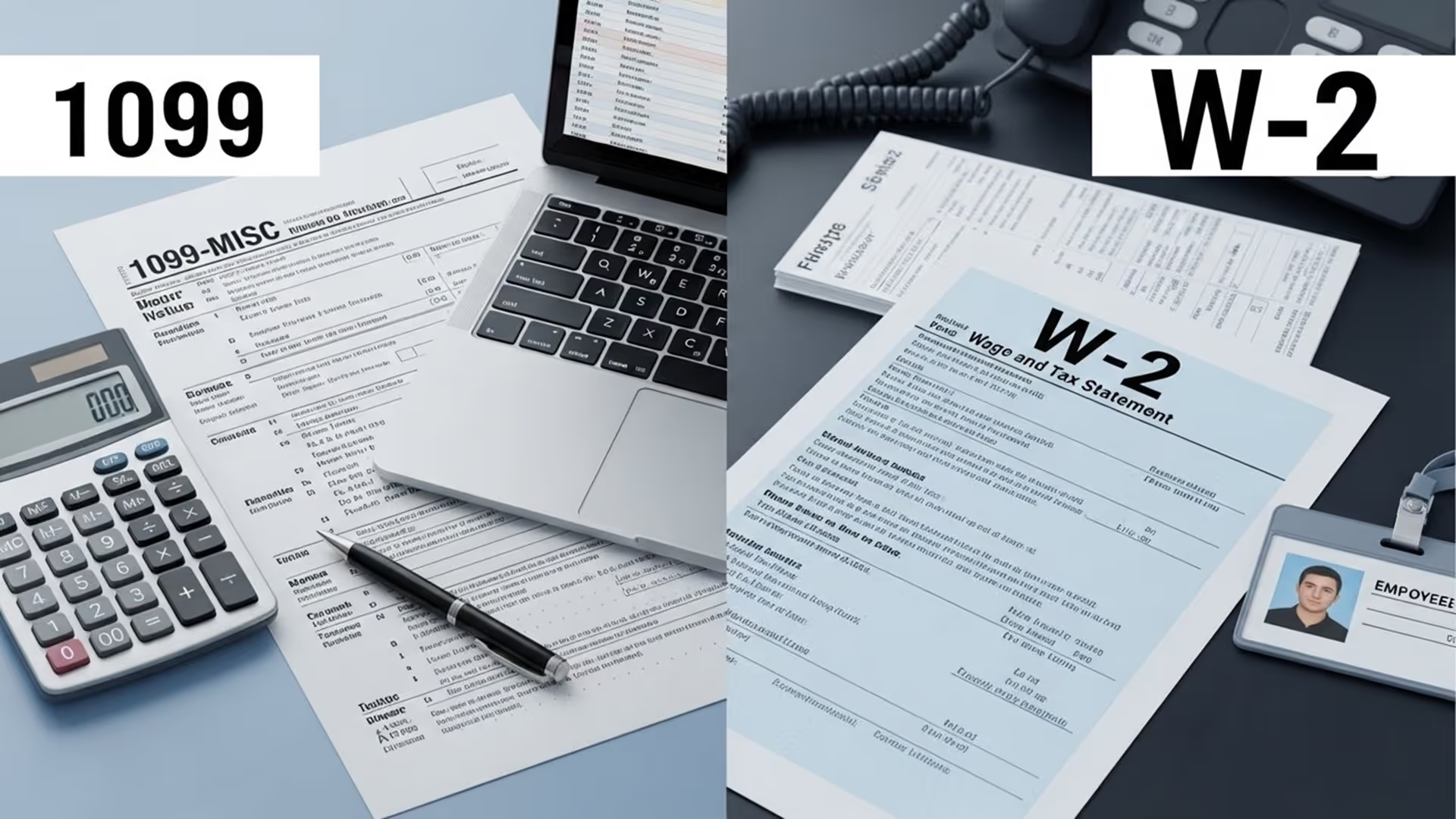
Are you misclassifying your team? Learn the critical differences between 1099 and W-2 workers, IRS rules for 2026, and how to avoid costly penalties in NY & CA.
As the 2026 tax season approaches, the landscape of the American workforce continues to undergo a seismic shift. For business owners, the decision to hire is no longer just about finding the right talent; it’s about navigating a high-stakes regulatory environment. The line between an independent contractor (1099) and a full-time employee (W-2) has never been more scrutinized by federal and state agencies.
With the rise of hybrid work models and the "gig economy" becoming a permanent fixture of the US economy, the IRS has modernized its tracking systems. In 2026, automated data matching between business filings and individual tax returns makes it easier than ever for authorities to flag inconsistencies. For a business owner, choosing between a 1099 and a W-2 classification is not just a matter of administrative preference or payroll convenience—it is a critical legal and financial pillar that determines your company’s vulnerability to audits.
Misunderstanding these roles can lead to a "domino effect" of financial consequences. What starts as a small saving on payroll taxes can quickly escalate into a multi-year audit, back-tax liabilities, and legal fees that could potentially bankrupt a growing enterprise. This guide is designed to provide you with the clarity needed to navigate these complexities with confidence.
The IRS and Department of Labor (DOL) have increased their oversight on worker classification. Proper classification ensures that you are paying the correct amount of social security, Medicare, and unemployment taxes. If you wait until you are filing your 1099-NEC or W-2 forms in January to decide a worker’s status, you are likely already in violation of federal labor laws.
The IRS does not take misclassification lightly. If the IRS determines that you treated an employee as an independent contractor without a reasonable basis, you may be held liable for:
Most businesses fail here because they focus on the "method of payment" rather than the "nature of control." Just because a worker agrees to be a contractor doesn't mean the IRS will see it that way. At GTA Accounting Group, we often see business owners prioritize short-term cash flow over long-term compliance, leading to audits that could have been easily avoided with a proactive classification review.
A 1099 worker is a business entity or individual that provides services to your company under a specific contract. They are not "employees" in the traditional sense; rather, they are independent business owners themselves who provide their expertise to multiple clients.
The 1099-NEC (Non-Employee Compensation) is the primary form used to report payments made to independent contractors. If you pay a contractor $600 or more during the tax year for services rendered in your trade or business, you must issue this form.
1099 contract work is defined by the outcome. You hire a 1099 worker to achieve a specific result—such as building a website, auditing a financial statement, or designing a marketing campaign. You do not direct how the work is done, only what the final product should be.
Technically, there is no such thing as a "1099 employee." The term is a legal oxymoron. A person is either an employee or an independent contractor. To qualify as a contractor, the person must maintain a separate business, use their own tools, and have the ability to realize a profit or loss from the engagement.
The primary rule is independence. A 1099 worker:
A W-2 employee is an individual who works under the direct control and supervision of an employer. They are an integral part of your business operations.
The W-2 (Wage and Tax Statement) is the form used to report annual wages paid to employees and the amount of taxes withheld from their paychecks. Employers must file these with the Social Security Administration (SSA) and provide a copy to the employee by January 31st.
A W-2 employee is hired under an implied or written contract where the employer has the right to control the details of how services are performed. Whether or not the employer actually exercises that control is irrelevant; the right to control is what defines the relationship.
Anyone who performs services for a business is generally considered an employee unless the employer can prove they meet the independent contractor criteria. If you provide the office space, the computer, the training, and the schedule, that person is a W-2 employee.
W-2 employees are entitled to several protections and benefits that 1099s are not:
The distinction between these two roles dictates your tax liability and your legal exposure.
| Feature | W-2 Employee | 1099 Independent Contractor |
|---|---|---|
| Control | Employer decides how, when, and where the work is performed. | Contractor decides the method and schedule of work. |
| Taxes | Employer withholds income tax and pays half of FICA taxes. | Contractor pays full self-employment (SECA) taxes. |
| Equipment | Tools and equipment are provided by the employer. | Contractor provides their own tools and equipment. |
| Duration | Generally ongoing or permanent employment. | Typically project-based or temporary arrangement. |
| Exclusivity | Often works for a single employer. | May work for multiple clients simultaneously. |
| Benefits | May include health insurance, 401(k), and paid time off. | No employer-provided benefits. |
For a W-2 employee, the employer is responsible for withholding federal income tax and paying a portion of Social Security and Medicare. For a 1099 worker, the employer simply pays the gross amount agreed upon in the contract. The 1099 worker is then responsible for paying both the employer and employee portions of those taxes.
With W-2 employees, you must manage a complex payroll system. This includes FICA (15.3% total, split between you and the employee), FUTA (Federal Unemployment Tax), and SUTA (State Unemployment Tax). With 1099s, your only "payroll" responsibility is ensuring you have a W-9 on file and issuing the 1099-NEC at year-end.
W-2 employees are protected by the Fair Labor Standards Act (FLSA), Title VII of the Civil Rights Act, and the Family and Medical Leave Act (FMLA). 1099 workers are generally not covered by these laws, as their relationship with you is governed by contract law rather than labor law.
The IRS uses a "Common Law" test to determine classification, grouped into three categories.
Does the business have the right to direct and control how the worker does the task?
Does the business have the right to control the business aspects of the worker’s job?
How do the parties perceive their relationship?
If you are genuinely confused about a worker’s status, you can file Form SS-8 with the IRS. The IRS will review the facts and provide a formal determination. However, be warned: the IRS almost always leans toward classifying workers as W-2 employees to ensure tax collection.
In 2024 and 2025, the DOL shifted toward the "Economic Reality Test." This focuses on whether the worker is economically dependent on the employer or is truly in business for themselves. They look at the "totality of the circumstances," meaning no single factor decides the case. If the worker’s service is an integral part of your primary business (e.g., a plumber working for a plumbing company), they are almost certainly an employee.
Federal rules are only the baseline. States like New York and California have much stricter standards that can catch US business owners off guard.
New York uses the "Common Law" test but applies it aggressively, especially regarding unemployment insurance. The New York Department of Labor often presumes a worker is an employee unless the business can prove otherwise. Industries like construction and "gig economy" apps are under constant surveillance in NY.
California uses the toughest standard in the country: the ABC Test (codified by AB5). To classify a worker as a 1099 contractor in California, you must prove:
States have a vested interest in workers being classified as W-2 employees because it funds state unemployment and disability pools. For businesses in NY and CA, meeting the IRS "behavioral" test is not enough; you must meet the specific state mandates or face heavy litigation and back-tax demands.
The financial difference between these two can be 20% to 30% per worker.
For a $50,000 salary:
Contractors pay the full 15.3% self-employment tax. Because they bear this burden, they often charge higher hourly rates than W-2 employees to cover their own taxes and benefits.
Managing W-2 payroll requires sophisticated software or a dedicated accounting firm. You must track hours, withhold the correct local/state/federal taxes, and remit them on a strict schedule (bi-weekly or monthly).
In the short term, 1099s are cheaper. However, if your business relies on that worker's daily availability and specific expertise for its core operations, the "cost" of a potential IRS audit makes W-2 the more cost-effective (and safer) long-term choice.
| Type | Pros | Cons |
|---|---|---|
| 1099 | No payroll taxes, no employee benefits, and easier termination process. | Less control over work quality and schedule; risk of worker misclassification penalties. |
| W-2 | Full control over employee performance, stronger brand loyalty, and consistent output. | Higher tax burden, benefit costs, and legal exposure (overtime and employment claims). |
Misclassification is not just a "mistake"—in the eyes of the law, it’s often viewed as wage theft or tax evasion.
The IRS can demand 100% of the unpaid employer taxes plus a penalty of up to 40% of the employee’s share of FICA taxes that you failed to withhold.
The DOL can force you to pay back-wages for overtime that a "contractor" worked but wasn't paid for, going back up to three years.
In California, willful misclassification carries civil penalties of $5,000 to $25,000 per violation. New York can impose heavy interest rates on unpaid unemployment insurance.
In extreme cases where a business intentionally uses 1099 status to evade taxes or defraud the government, criminal charges and jail time for business owners are possible.
Ask yourself these four questions:
Is this a 3-month project (1099) or a permanent role (W-2)?
Do you need to tell them how to do the work, or just what the result should be? If you need a specific process followed, hire a W-2.
If this role is vital to your company’s growth and scaling, having a W-2 employee ensures that the knowledge stays within your firm.
Before you sign a contract or send the first payment, consult with a professional. A CPA can help you structure your contracts to meet the "independent" criteria or set up a compliant payroll system.
No. A 1099 is for independent contractors who handle their own taxes. A W-2 is for employees where the employer withholds taxes.
For the employer, it's cheaper and more flexible. For the worker, W-2 offers more security and benefits.
Legally, no. Providing benefits to a 1099 worker can actually be used as evidence by the IRS that they are actually an employee.
The main difference is the level of control the employer has and who is responsible for paying employment taxes.
A checklist includes: No set hours, provides own tools, works for others, paid per project, and has a written contract.
Yes, and many businesses do this as they grow. However, you cannot switch them back and forth just to avoid taxes during busy seasons.
A W-2 job means you are on the company’s official payroll, they direct your work, and they withhold taxes from your paycheck.
The complexity of 1099 vs W-2 classification in 2026 requires more than just a "gut feeling." With states like California and New York tightening their definitions, the risk to your business has never been higher. Proactive compliance is the only way to protect your assets and ensure your business's longevity.
At GTA Accounting Group, we specialize in helping US-based businesses navigate these murky waters. We don't just file your forms; we ensure your business structure is audit-proof.
GTA Accounting Group can help you with:
Experience the difference with our tailored accounting solutions. Let's transform your financial landscape together. Get in touch for a consultation!
Get in touch
At GTA Accounting Group, we value proactive clients — which is why when you book an appointment, you'll also receive an exclusive offer designed to help you save more, plan better, and make confident financial decisions.
Simply fill out the form, and our team will reach out to confirm your appointment and deliver your award. It only takes 30 seconds and gets you one step closer to expert support.
Use the form below to